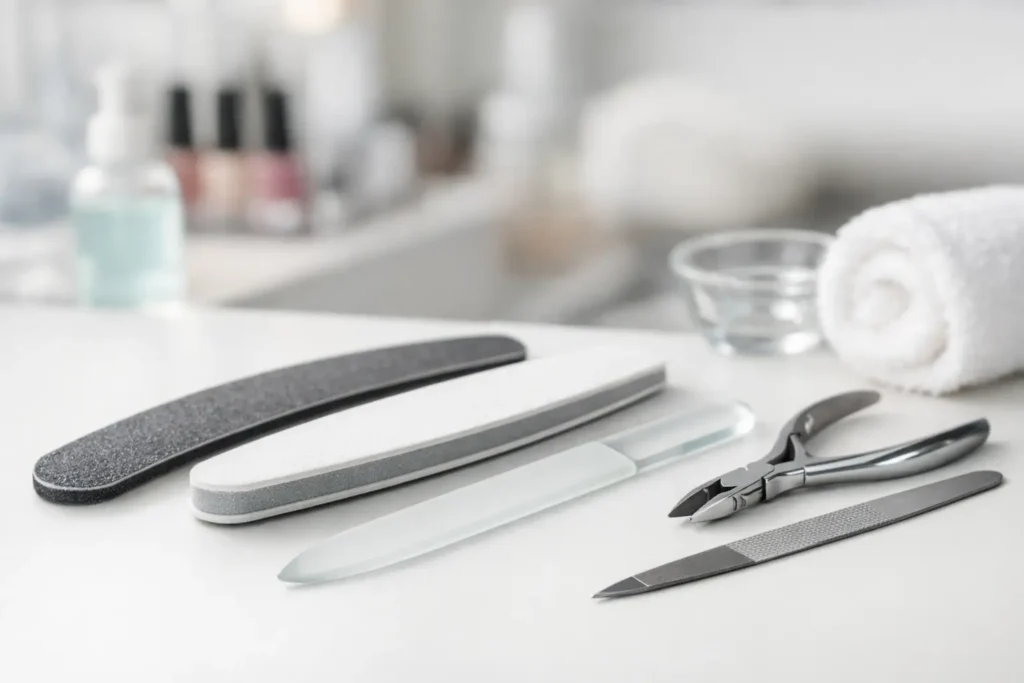
A file can change the entire finish of a set. When clients ask what nail files do professionals use, the answer is rarely just one type. In a salon setting, nail techs work with different file materials, grit levels, and shapes depending on whether they are refining natural nails, shortening Gel X, perfecting BIAB, or shaping acrylic.
The best professional result comes from choosing the right file for the service, not using the same one for every step. That is where technique, safety, and attention to detail matter most.
What nail files do professionals use in salons?
Professional nail techs usually use a mix of emery boards, zebra files, cushioned files, wooden files, glass files, and buffers. The exact choice depends on the nail service and the condition of the natural nail underneath.
For enhancement services like acrylic or hard gel, professionals often reach for stronger files with lower grit numbers because they remove product more efficiently. For natural nails, the approach is gentler. A finer grit helps smooth and shape without causing peeling or weakening at the edge.
This is why salon-quality filing looks so clean. It is not just about shaping faster. It is about preserving nail health while creating a refined, balanced finish.
Understanding grit makes all the difference
If you have ever looked at a nail file and noticed numbers like 100/180 or 180/240, those numbers refer to grit. Lower numbers are coarser and remove more product. Higher numbers are finer and create a smoother finish.
A 100 grit file is quite coarse and is generally used for reducing bulk on acrylics or other enhancements. A 180 grit file is one of the most common salon staples because it is versatile enough for shaping product while still controlled. A 240 grit file is softer and better suited to refining natural nails or finishing delicate edges.
For clients, this is often the part that gets overlooked. A file is not automatically professional because it feels sturdy or expensive. The grit has to match the service. Using a file that is too coarse on natural nails can leave them frayed, thin, or more likely to split.
The grit professionals typically use for natural nails
For natural nails, most professionals prefer a 180 grit or 240 grit file. These finer grits allow the free edge to be shaped neatly without creating too much abrasion.
Glass files are also popular for natural nail appointments because they seal the edge beautifully and feel very smooth against the nail. They are especially useful for clients who are growing their nails, wearing minimal product, or trying to avoid breakage.
The grit professionals use for acrylic, BIAB, and gel
Acrylic usually calls for a coarser file, often 100 or 150 grit, especially when reducing thickness or refining structure. BIAB and gel services often sit in the middle. Many technicians use 150 or 180 grit for shaping and surface refining, then switch to a buffer to smooth everything before top coat.
The key is control. A professional does not press harder just to work faster. They choose the grit that lets them shape accurately while keeping the service comfortable and precise.
The file materials professionals trust most
Not all nail files are made from the same material, and that affects how they perform. In salons, durability and consistency matter because every file needs to deliver predictable results.
Emery boards are familiar and widely used, but many professionals prefer higher-quality salon files for regular enhancement work. Zebra files are a popular choice because they are durable, easy to handle, and effective for shaping product. Cushioned files are also common because they feel more comfortable in the hand and offer a bit more flexibility during detailed work.
Glass files stand out in natural nail care. They are gentle, refined, and ideal for clients who want a polished shape without roughness. Wooden core files are another salon staple because they provide stability and crisp control, especially when creating square or coffin shapes.
What matters most is not the label alone. It is whether the file cuts cleanly, holds its grit well, and suits the service being performed.
Shape matters too
The shape of the file influences how a nail tech works around the nail. Straight files are excellent for sidewalls and sharp, structured shaping. Crescent or banana-shaped files help around the cuticle area and contour more comfortably without feeling awkward.
Professionals usually keep more than one file shape at their station because different nail shapes call for different tools. Almond and oval nails often benefit from a file that can move fluidly around the edges. Square or tapered square designs may need a straighter file for crisp symmetry.
This is one of those details clients notice even if they do not realize it. Balanced nails look elegant because the shaping process is consistent from every angle.
Why professionals do not use one file for everything
A single file cannot do every job well. Coarse files are too aggressive for natural nail finishing, while very fine files can make enhancement shaping slow and inefficient.
In a professional salon, the file changes as the service progresses. One may be used to shorten length, another to refine structure, and another to soften the final shape. Buffers then smooth the surface and remove minor scratches before polish, gel, or top coat is applied.
That layered approach is part of what gives professional nails their clean silhouette and smooth finish. It also reduces unnecessary friction, which helps keep both natural nails and enhancements in better condition.
What professionals use for different nail services
For a classic manicure, professionals often use a 180 or 240 grit file, sometimes followed by a glass file for final refinement. The goal is a neat shape that supports the natural nail rather than overworking it.
For BIAB, many techs use a 180 grit file to shape and refine the overlay without being too harsh on the natural nail beneath. The file needs enough strength to perfect the apex and side profile, but still allow a soft, elegant finish.
For Gel X, professionals often shape the extension with a medium grit file after application. This helps blend, shorten, and tailor the final look to the client’s preferred style.
For acrylics, stronger grit files are more common during the structure phase. Acrylic is denser, so the file has to remove product efficiently while maintaining shape and balance.
For pedicures, the approach can vary. Toenails often need durable shaping tools, but the file still needs to be gentle enough to avoid rough edges or discomfort.
Professional standards go beyond the file itself
When clients ask what nail files do professionals use, they are often really asking a bigger question: what creates a salon-quality result? The file matters, but so does hygiene, consistency, and the way the tool is used.
Professional nail techs are mindful about file quality, sanitation protocols, and when to replace worn tools. A file that has lost its grit becomes less precise. A file that is too old can drag rather than shape cleanly. In many salons, single-use files or client-dedicated files are part of maintaining a clean and thoughtful service standard.
Technique matters just as much. Filing with too much pressure, filing back and forth too aggressively on natural nails, or choosing the wrong grit can compromise the final look and the nail itself. A polished result comes from controlled movement, strong product knowledge, and attention to the client’s nail type.
How to tell if your nail tech is using the right file
You do not need to know every grit number to notice good technique. The filing should feel controlled, not harsh. Your natural nails should not feel thin or sore afterward. Enhancements should look smooth and even, without deep scratches under the top coat.
You can also expect your tech to adapt. A client with thin natural nails, frequent peeling, or a history of breakage may need a gentler approach than someone wearing a full acrylic set. Personalization is part of professional care.
At Natural Nails & Beauty, that attention to detail is part of what makes a service feel both refined and reassuring. The right file supports the shape, the strength, and the finish, but it also supports the overall experience.
The best nail file is never just the one in hand. It is the one chosen with purpose, used with care, and matched to the nails in front of it.